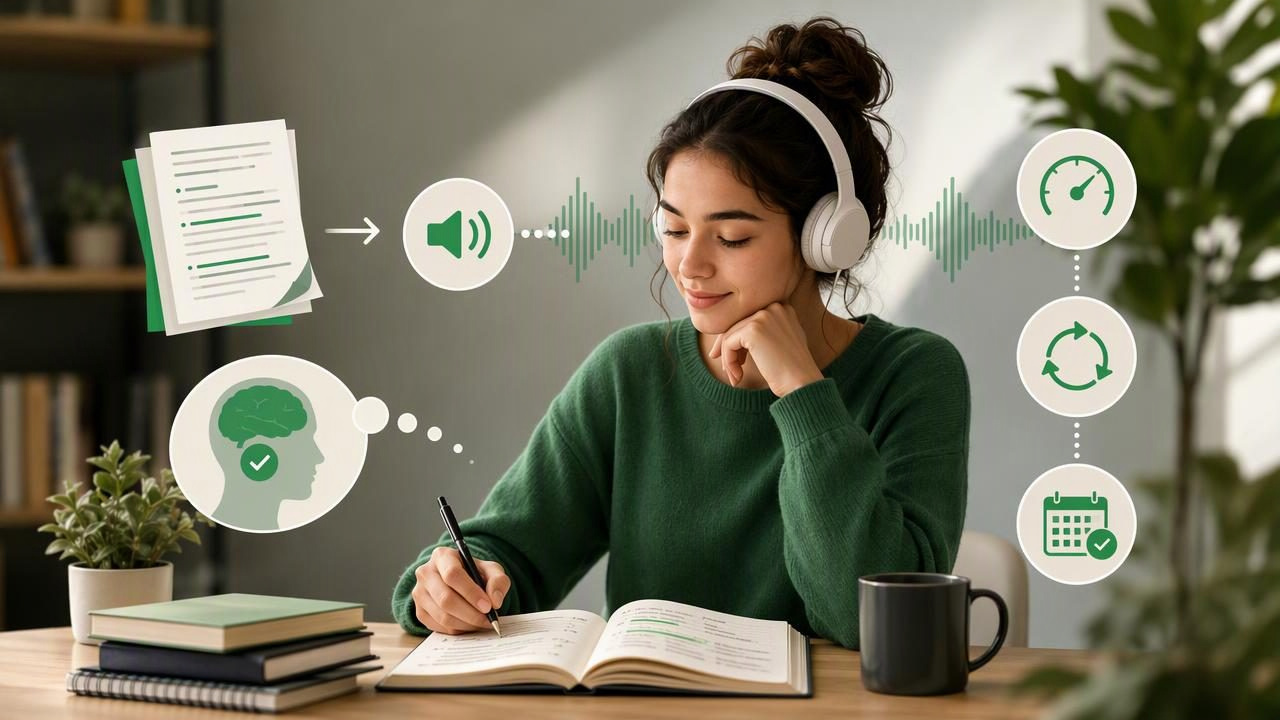
Knowing how to review study notes by listening can make revision more flexible, accessible, and easier to fit into a busy day. Instead of reserving every review session for a desk, you can turn outlines, flashcards, lecture summaries, textbook excerpts, and PDFs into audio you can revisit while walking, commuting, cleaning, or resting your eyes.
Listening is not a replacement for every study method. You still need practice questions, retrieval practice, written work, and focused reading. However, when used intentionally, audio review can help you revisit material more often, reinforce major ideas, and make productive use of time that would otherwise be unavailable for studying.
This guide explains how to turn notes into useful listening material, how to stay active rather than passive, and how to build an audio revision routine that supports real learning.
Why Review Study Notes by Listening?
Traditional review usually depends on visual attention: rereading pages, highlighting passages, or looking at flashcards. Those methods can be valuable, but they are not always practical. You may be tired after a long day, travelling between classes, or trying to study around work and family responsibilities.
Listening creates another route back to the material. A text-to-speech app can narrate digital notes, PDFs, web articles, and pasted text, allowing you to hear the same concepts repeatedly without needing to keep your eyes on a screen.
- More review opportunities: Listen during low-focus activities such as walking or commuting.
- Better repetition: Revisit difficult concepts several times across the week.
- Reduced visual fatigue: Give your eyes a break after reading slides, textbooks, and screens all day.
- Accessibility support: Audio can be especially helpful for learners with dyslexia, ADHD, visual strain, or reading fatigue.
- Flexible pacing: Slow down dense material or speed up familiar summaries.
The key is to treat listening as an active review tool, not background noise. Simply playing notes while your attention is elsewhere will not reliably prepare you for an exam. Effective audio review includes pauses, questions, repetition, and follow-up recall.
What Types of Notes Work Best as Audio?
Not every page of notes is equally easy to understand when read aloud. A heavily formatted chemistry table, a complex graph, or a page filled with abbreviations may need some editing first. The best audio study materials are clear, structured, and written in complete language.
| Study Material | How Well It Works for Listening | Best Approach |
|---|---|---|
| Lecture summaries | Excellent | Listen once for overview, then pause for recall. |
| Essay plans | Excellent | Hear each argument and mentally explain the evidence. |
| Flashcards | Very good | Leave a pause after each question before hearing the answer. |
| Textbook chapters | Good | Listen to selected sections rather than an entire chapter at once. |
| Formula sheets | Moderate | Pair audio with visual review and worked examples. |
| Diagrams and charts | Limited alone | Review visually first, then listen to a verbal explanation. |
Before converting notes to audio, simplify any material that depends heavily on layout. Replace symbols with spoken explanations where needed. For example, instead of relying on a table alone, write a short sentence that states what the table shows and why it matters.
Step 1: Prepare Notes for Clear Narration
Clean notes are easier to understand aloud. This does not mean rewriting every page from scratch. It means making small changes that help the narration flow naturally and help you remember what you hear.
Use descriptive headings
Headings tell you where you are in the topic. Rather than writing “Week 4,” use “Week 4: Causes of the French Revolution” or “Cell Biology: Mitochondria and ATP Production.” When reviewing audio later, these signposts make it easier to reconnect with the lesson structure.
Turn fragments into short statements
Bullet-point fragments are fast to write, but they can sound confusing through text to speech. Expand especially important ones into complete sentences.
Original note: Photosynthesis - light reactions - ATP/NADPH
Audio-ready note: During the light reactions of photosynthesis,
plants use light energy to produce ATP and NADPH.
Spell out abbreviations once
If a course uses specialized shorthand, write the full term before using the abbreviation. This prevents unclear narration and reinforces technical vocabulary. For example: “Cognitive behavioral therapy, or CBT, focuses on the relationship between thoughts, feelings, and behaviors.”
Add verbal cues for visuals
For a graph or diagram, add a note such as: “The graph rises sharply between 2000 and 2010, showing rapid growth during that period.” You can then listen to the interpretation even when you are away from the image.
Step 2: Create an Audio Review Queue
A large pile of files can make audio studying feel unfocused. Instead, build a small, deliberate queue. Group files by subject, unit, or exam topic, and give them names you will recognize quickly.
A useful weekly queue might include:
- A five-minute overview of the current unit.
- One lecture summary with key definitions.
- A short list of common exam questions.
- A difficult topic that needs repeated exposure.
- A final recap recorded or generated from your own condensed notes.
Keep individual sessions manageable. For dense academic material, 10 to 20 minutes is often more useful than playing an hour-long document without stopping. Shorter files also make it easier to repeat a difficult section until it becomes familiar.
Step 3: Listen Actively, Not Passively
The most important part of learning how to review study notes by listening is knowing when to pause. Your brain needs opportunities to retrieve information, connect ideas, and notice what it does not yet understand.
Use the pause-and-recall method
Pause after a definition, process, argument, or question. Then say the answer aloud or silently explain it in your own words before restarting the audio. This turns listening into retrieval practice.
Simple rule: If you can only recognize an answer when you hear it, you have not fully learned it yet. Pause first and try to produce it yourself.
Ask questions while you listen
Use prompts that match the demands of your course:
- What is the main claim of this section?
- Can I define this term without looking at my notes?
- What caused this event, and what happened next?
- How would I apply this formula to a new problem?
- What evidence supports this essay point?
For exam preparation, create an audio file that alternates between questions and answers. Leave a few seconds of silence after each question, so you can respond before hearing the explanation.
Step 4: Choose a Listening Speed That Supports Understanding
Playback speed can make review far more efficient, but faster is not always better. The right speed depends on how familiar and complex the material is.
- 0.8x to 1x: New, technical, or difficult content.
- 1.25x to 1.5x: Standard review of familiar lecture notes.
- 1.75x to 2x: Quick recaps and material you already know well.
- Above 2x: Best reserved for very familiar content or scanning for a specific section.
If you repeatedly rewind a passage, lower the speed. Efficiency is not about finishing audio quickly; it is about retaining enough to answer questions later. Natural AI voices can also make longer sessions more comfortable because clear pacing and pronunciation reduce the mental effort required to follow along.
Step 5: Pair Audio With Other Evidence-Based Study Methods
Audio revision works best as part of a larger system. Use listening to introduce, reinforce, and revisit material, then test your knowledge in a format similar to the assessment.
A practical study cycle
- Read or attend: Learn the material through lectures, chapters, demonstrations, or class discussion.
- Condense: Create a clear summary with headings, definitions, examples, and likely questions.
- Listen: Review the summary during a walk, commute, or short break.
- Recall: Pause the audio and explain major points without notes.
- Test: Complete practice problems, past-paper questions, or flashcards.
- Repair gaps: Mark weak topics and add them back to your audio queue.
This approach also works well with spaced repetition. Listen to a topic on the day you learn it, again a few days later, then once more the following week. Each revisit should include more self-testing and less passive replay.
Common Mistakes to Avoid
Audio study is convenient, which can make it easy to overestimate how much you are learning. Avoid these common problems:
- Listening while doing demanding work: Do not expect to learn complex material while writing emails, gaming, or holding a detailed conversation.
- Never pausing: Continuous playback can create familiarity without recall.
- Using unedited notes: Messy abbreviations, broken sentences, and unreadable scans make narration less useful.
- Skipping practice: Listening cannot replace solving problems, writing essays, or answering exam-style questions.
- Relying on one format: Combine audio with visual diagrams, active recall, and hands-on application where appropriate.
Build a Repeatable Listening Routine
A simple routine is more likely to last than an ambitious one. Try reserving one predictable moment each day for review: a morning walk, bus ride, lunch break, or evening reset. Download materials in advance when possible, so offline listening is available even without reliable Wi-Fi.
At the end of each session, make a quick note of one idea you understood and one point that needs work. That small reflection helps you decide what to revisit next rather than repeatedly listening to only the easiest material.
For students who want to turn PDFs, documents, web sources, typed notes, or camera scans into organized audio, tools such as Focal Voice can support a flexible listening-based revision workflow. The best setup is ultimately the one that helps you pause, recall, test yourself, and return to difficult concepts consistently.
Final Takeaway
Learning how to review study notes by listening is about more than pressing play. Prepare clear notes, listen in short focused sessions, pause for retrieval, adjust the speed, and follow each audio review with meaningful practice. Used this way, text to speech can turn spare moments into valuable revision time while supporting a more varied and accessible study routine.
